
The Story Behind the Collection: Ghosts in the Glass

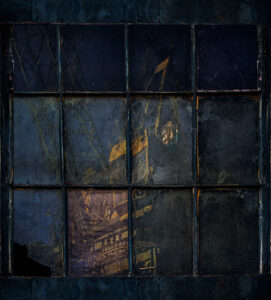 Behind the Glass: The Making of “Ghosts in the Glass”
For the past year, I have been immersed in the storied legacy of Mare Island Naval Shipyard. What began as a curiosity about its 142-year naval history evolved into a deep, emotional investigation of what remains when a place of such immense power falls silent. This series, Ghosts in the Glass, is the result of that journey—a visual echo of an era that helped shape a nation.
The Patience of Place
Establishing this body of work required more than a single afternoon of shooting. The process evolved over four to five distinct visits to the island. I learned quickly that the character of these buildings is revealed only through the light.
Consistent lighting was my primary objective to ensure the reflections were rendered with the right emotional weight. The windows reflected best in the late afternoon, and I often found myself returning to the same structure multiple times, waiting for the sun to reach a specific angle that would allow the “ghosts”—the reflections of cranes and dry docks—to blur seamlessly with the shadows inside.
The Technical Threshold
While the capture required patience, the post-production for Ghosts in the Glass was a complex technical challenge. To achieve the intimacy I was looking for, almost none of these reflections could be shot straight-on. This meant every image required substantial perspective adjustment in Photoshop to correct skewed viewpoints and restore the architectural integrity of the frames.
Once the geometry was corrected, I moved into establishing a specific “character” through color and texture:
- Color Grading: I developed a base palette dominated by cool, desaturated blues to evoke the melancholy and passage of time inherent in these decaying structures.
- Textural Layering: To mirror the physical decay of the shipyard, I layered two distinct texture overlays—a subtle grunge layer and a worn concrete overlay. This added a tactile, aged quality that makes the digital image feel as weathered as the buildings themselves.
Beyond Representation
This project was a deliberate move toward an impressionistic style. I didn’t want to simply document “what is”; I wanted to convey my emotional response to the resilience and sacrifice embedded in these walls.
As I work through the Artist Proofs on Epson Platine, I am reminded that these windows are more than glass and lead—they are thresholds between the thrumming life of the past and the stillness of the present.